
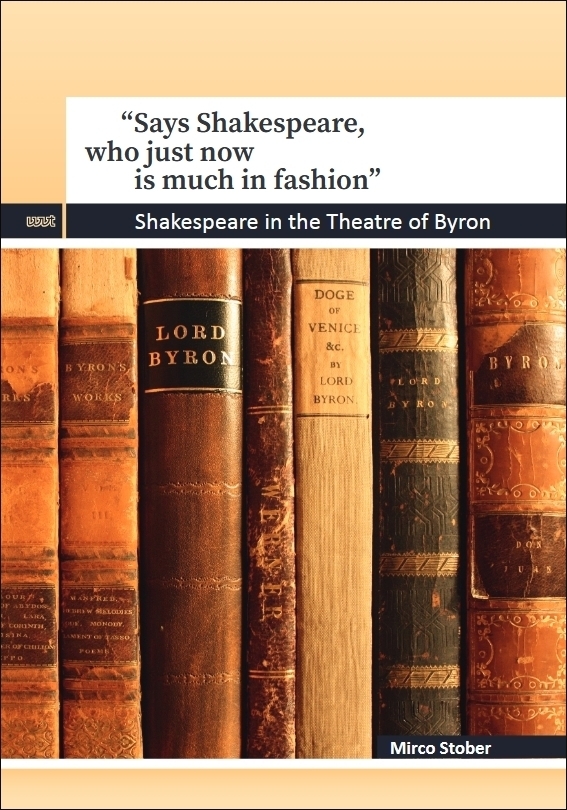
“Says Shakespeare, who just now is much in fashion”. Shakespeare in the Theatre of Byron
Description
Mirco Stober
“Says Shakespeare, who just now is much in fashion”. Shakespeare in the Theatre of Byron
ISBN 978-3-98940-011-5, 226 pp., paperback, € 29,50 (2024)
This study focusses on Byron’s largely disregarded career as a playwright and establishes Shakespeare as an important infl uence on his plays. This brings them closer to stage representation although Byron himself claimed that his plays are unsuitable for the contemporary London stage and that Shakespeare, the dominant presence on said stage, is “the worst of models—though the most extraordinary of writers”. Following an introduction to the Romantic stage and a brief survey of Shakespeare’s status in the Romantic age and on its stage, this study analyses examples of Byron’s engagement with the London stage during the years 1812-16 – his “Address, Spoken at the Opening of Drury Lane Theatre”, his friendship with Edmund Kean, as well as his time on the Drury Lane Subcommittee – showing that Byron is a clear advocate for the representation of Shakespeare’s plays on the contemporary stage. Next this study reconciles Shakespeare with other elements of Byron’s poetics such as neoclassicism or the Gothic before finally demonstrating that five of Byron’s plays – Manfred (1817), Marino Faliero (1821), Sardanapalus (1821), The Two Foscari (1821), and Werner (1822) – are heavily influenced by Shakespeare’s plays and that this influence brings each play closer to representation on the contemporary stage, belying both of Byron’s claims.
Preview / Table of Contents (pdf)